Table of Contents
Sound Bridge Through the Centuries: uscor Revives Hildegard von Bingen’s Phrygian Visions
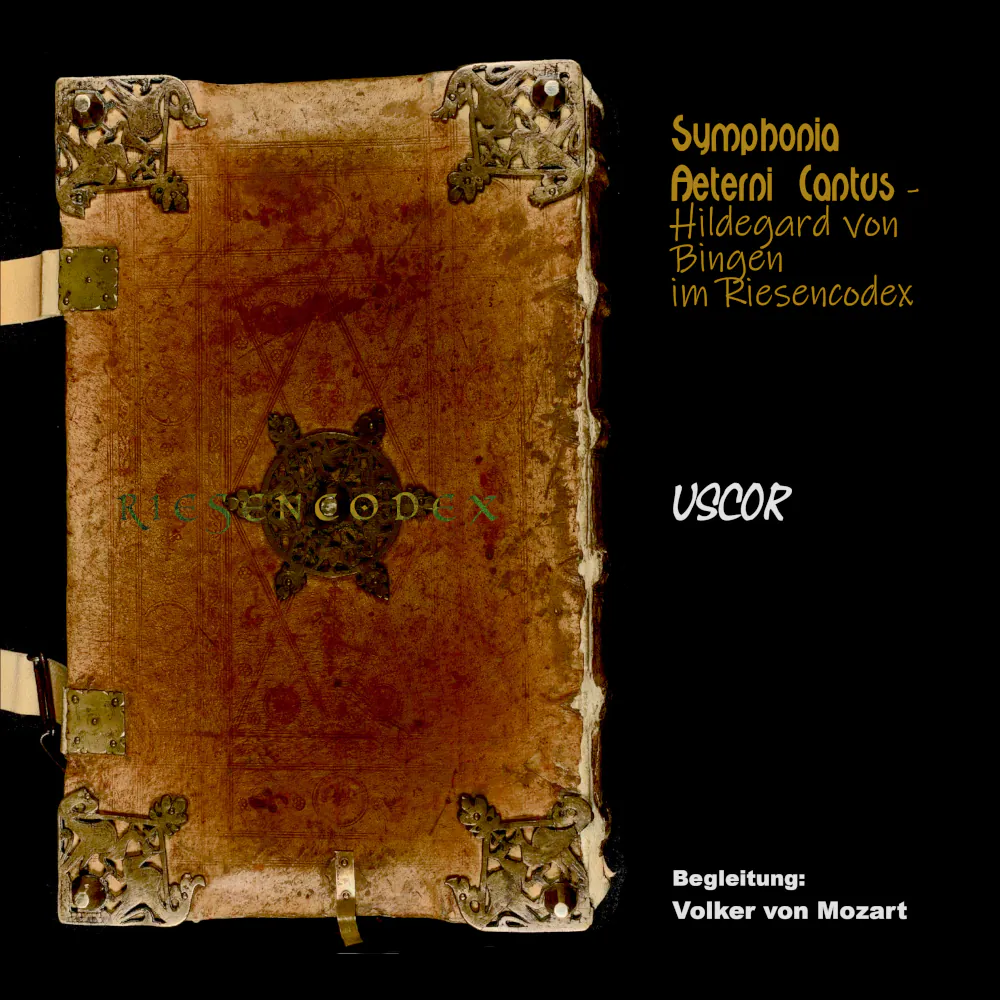
Medieval music continues to fascinate us today with its raw, spiritual power and its unique ability to catapult the listener straight out of the daily grind into a sphere of pure transcendence. At the absolute center of this fascination stands a woman whose work shook the 12th century and still resonates today: Hildegard von Bingen. With the album “Symphonia Aeterni Cantus (Hildegard von Bingen im Riesencodex)”, released in August 2026 via the SCHALLROLA label, the music project uscor—together with Volker von Mozart (Harp), Volker Wolfgang Schidlowski (Orchestration)—builds a masterful bridge between the original compositions of the mystic and modern soundscapes [Symphonia Aeterni Cantus (Hildegard von Bingen im Riesencodex). Apple Music, Amazon Music and Spotify, they have the tracks for streaming. Even download the songs at iTunes or Amazon.
The project focuses on three interconnected antiphons, all based on Hildegard’s famous responsory: O vis eternitatis, utilizing the fascinating Phrygian mode: O vis aeternitatis quae omnia, O quam magna est benignitas, and A maximo dolore. But what exactly makes this music, this specific mode, and Hildegard’s style of singing so unique?
The Phenomenon of Hildegard von Bingen: Prophetess of Sound
Hildegard von Bingen (1098–1179) was a true polymath: an abbess, scientist, healer, and visionary theologian. For Hildegard, music was never a mere pastime or just a functional part of the daily monastic routine. She viewed music as the highest form of human expression—a sacred bridge that connected humanity back to the heavenly choir of angels before the Fall. To her, singing was a form of prophecy and a restoration of the original harmony of creation.
Her compositions, mostly preserved in the famous Riesencodex (a monumental comprehensive manuscript of her works created around 1180), completely shattered the tight, rigid boundaries of the traditional Gregorian chant of her era.
What Makes Hildegard’s Chant So Special und the vocals fo uscor so amazing
When listening to traditional medieval Gregorian chants, one usually notices a calm, wave-like motion within a very narrow vocal range. Hildegard von Bingen completely ignored these conventions. Her style, which she often referred to as Symphonia (harmony), stands out due to several distinct characteristics:
- Leaps Across Octaves: Hildegard did not shy away from soaring melodies. Her notes often climb ecstatically into the highest registers before plunging deeply back down, spanning up to two full octaves.
- Melismatic Splendor: She frequently placed extremely long chains of notes (melismas) onto a single syllable. The word is stretched out, almost as if language itself is surrendering to divine greatness.
- Emotional Urgency: While classical chants often feel detached, objective, and purely meditative, Hildegard’s music carries an almost physically palpable, burning intensity.
The Magic of the Phrygian Mode
The project uscor intentionally emphasizes the Phrygian mode on this album. In medieval church music, each mode carried its own distinct character, known as its ethos.
The Phrygian mode (which naturally runs from E to E on the white keys of a piano) has a striking feature: the very first step from the root note upward is a tiny half-step. This gives the mode an unmistakably yearning, mystical, and sometimes deeply sorrowful character. It is a mode of profound introspection, fitting perfectly with Hildegard’s visions, where light and darkness, divine power and human transience, collide.
The Trilogy of Eternity: The Tracks in Detail
The album Symphonia Aeterni Cantus artfully dissects the responsory O vis eternitatis into three distinct acts, produced by uscor with a fine intuition for medieval mysticism and contemporary textures:
- O vis aeternitatis quae omnia: This antiphon breathes the spirit of the beginning. It sets the lines “O power of eternity, who has ordered all things in your heart” to music. The Phrygian melody beautifully underscores the awe of the cosmic order.
- O quam magna est benignitas (Phrygisch): Here, the focus shifts to the boundless mercy of the Creator. In Hildegard’s theology, God looks upon suffering humanity with infinite love. The Phrygian mode provides a bittersweet, comforting atmosphere that makes the relief of the soul truly tangible.
- A maximo dolore (Phrygisch): This title is dedicated to the most dramatic turning point of the text. It describes how humanity, cleansed by the Incarnation, is wiped clean from the “greatest pain” and sorrow. The music mirrors this transformation—moving from deep Phrygian grief to spiritual liberation.
Conclusion: Timeless Mysticism in a Modern Guise
Medieval music is anything but a dusty relic of the past. When projects like uscor take on the visionary scores of Hildegard von Bingen, the absolute timelessness of these sounds becomes clear. The combination of Hildegard’s expressive melodies, the emotional depth of the Phrygian mode, and modern production techniques turns Symphonia Aeterni Cantus into an immersive listening experience. It is an invitation to close your eyes, escape the noise of the world, and dive straight into the infinite power of eternity.
| Track No. | Interpreten | Titel | Label | Spieldauer | ISRC | Abspielen |
|---|---|---|---|---|---|---|
| 1. | uscor | O magne pater in magna | SCHALLROLA | 00:04:17 | DEAR42660580 | |
| 2. | uscor | O aeterne deus nunc tibi | SCHALLROLA | 00:03:10 | ||
| 3. | uscor | O virtus sapientiae quae circuiens | SCHALLROLA | 00:01:59 |